
Safety. Compassion. Excellence.
Our goal at Skin Secrets is to provide trustworthy clinical care with exceptional service. Our staff is dedicated to your safety and comfort, and we provide attentive, compassionate care throughout your experience. Our surgical procedures, performed by Dr. Smith, are typically done under general anesthesia in our private surgery center (Surgery Center of Lawton).
-
(Eyelid Surgery)Blepharoplasty
-
Brow/Forehead Lifts
-
(Face Lift Surgery)Rhytidectomy
-
Liposuction
-
(Otoplasty)External Ear Repair
-
Skin Cancer
Removal/Reconstruction
Blepharoplasty (Eyelid Surgery)
Cosmetic improvement in the appearance of the upper and lower eyelids may require surgical removal of eyelid skin and fat from around the eyes. Tiny sutures and mild bruising and swelling after the procedure are usually noticed for the first few days. The sutures are generally removed on the 6th day after surgery. As the swelling begins to resolve over the first few weeks, the patient will notice an improvement in the overall tightness of the eyelids and a more youthful, rested appearance.
Blepharoplasty (surgery of eyelids) can be done on the upper, lower or all four eyelids. Generally surgery is done on the upper eyelids to remove fat and/or skin to improve the appearance of the upper lids. Functional (non-cosmetic) upper lid blepharoplasties are done to removal excessive skin from upper lids that block the vision, push against the lashes and push the eyelids down over the pupil of the eyes. Lower lid surgery is done to remove fat and/or skin from lower lids to improve the appearance of the lower lids. Although eyelid surgery is generally for cosmetic reasons and not covered by insurance, functional upper lid surgery is often covered by insurance plans including Medicare.
Indications for BLEPHAROPLASTY: Cosmetic vs Functional blepharoplasty
- Cosmetic concerns about excessive skin and/or fat in lids – excessive skin (dermatochalasis) or fat bulging in either the upper or lower lids can be corrected with a cosmetic blepharoplasty.
- Interference with vision – functional (non-cosmetic) upper lid blepharoplasty is covered by most insurance plans including Medicare. Medicare basically says that if the skin of the upper lids touches the lashes, they will cover the cost to remove that skin.
Why BLEPHAROPLASTY? As opposed to non-surgical treatment with lasers or lifting the brows
- Lasers are limited in the amount of skin that can be tightened – the Laser Lift can tighten some skin of the upper and lower lids but generally surgery is required to remove larger amounts of skin. Lasers cannot remove fat from the lids.
- Brow lifting can improve low hanging brows only – lifting the brows does not remove skin of the lids and may help clean up lid appearance only if the brows can be lifted some without distorting the cosmetic appearance of face. Brow lifts are also not covered by insurance
- Blepharoplasty is the only method to remove fat from the lids – although one of the “secrets” in Skin Secrets is that surgery is often not necessary to improve the cosmetic appearance of the face, only a blepharoplasty can remove eyelid fat.
- Functional blepharoplasty can be covered by insurance – most patients are very excited to learn that many times excessive skin of the upper lids can be removed with insurance coverage. Dr. Smith does multiple functional upper lid surgeries every week. Most of the eye doctors in the region refer to Dr. Smith to perform this surgery on their patients. Medicare and most insurance plans don’t require a referral to see Dr. Smith for this.
What to expect after a BLEPHAROPLASTY?
- Most patients have minimal bruising in recovery room – however, by the evening of surgery, most patients begin to bruise and swell. This is highly variable and depends upon patient use of blood thinners, genetics and extent of fat removal from the lids. This is generally worst when all 4 lids are done. Most bruising is gone within 7-10 days.
- Elevation of head of bed and use of ice will help bruising and swelling – use of ice at least 20 minutes every hour while awake for first 36 hours will reduce bruising and swelling.
- Sleeping on the back encouraged – by sleeping on their backs for a few weeks, patients will avoid pushing or pulling on the lids after surgery. This will reduce pain and swelling.
- Minimal pain – most patients report almost no pain if they take Tylenol routinely for 2-3 days and use ice.
- Suture removal in 10 days – upper lid sutures are removed in 10 days. Depending on healing the lower lid sutures may be removed in 6-7 days.
- Wearing eye makeup – this is variable but most patients can wear mascara after suture removal and eyeliner in 2-3 weeks.
What should I do next to get more information about BLEPHAROPLASTY?
- Watch the Dr. Smith videos – just click on “Dr. Smith videos” in section above
- View “before and after” pictures – just click on “before and after” photos in section above
- Schedule consultation with Dr.Smith – call the office or use the 24/7 chat after hours to schedule a private and personal consult with Dr. Smith
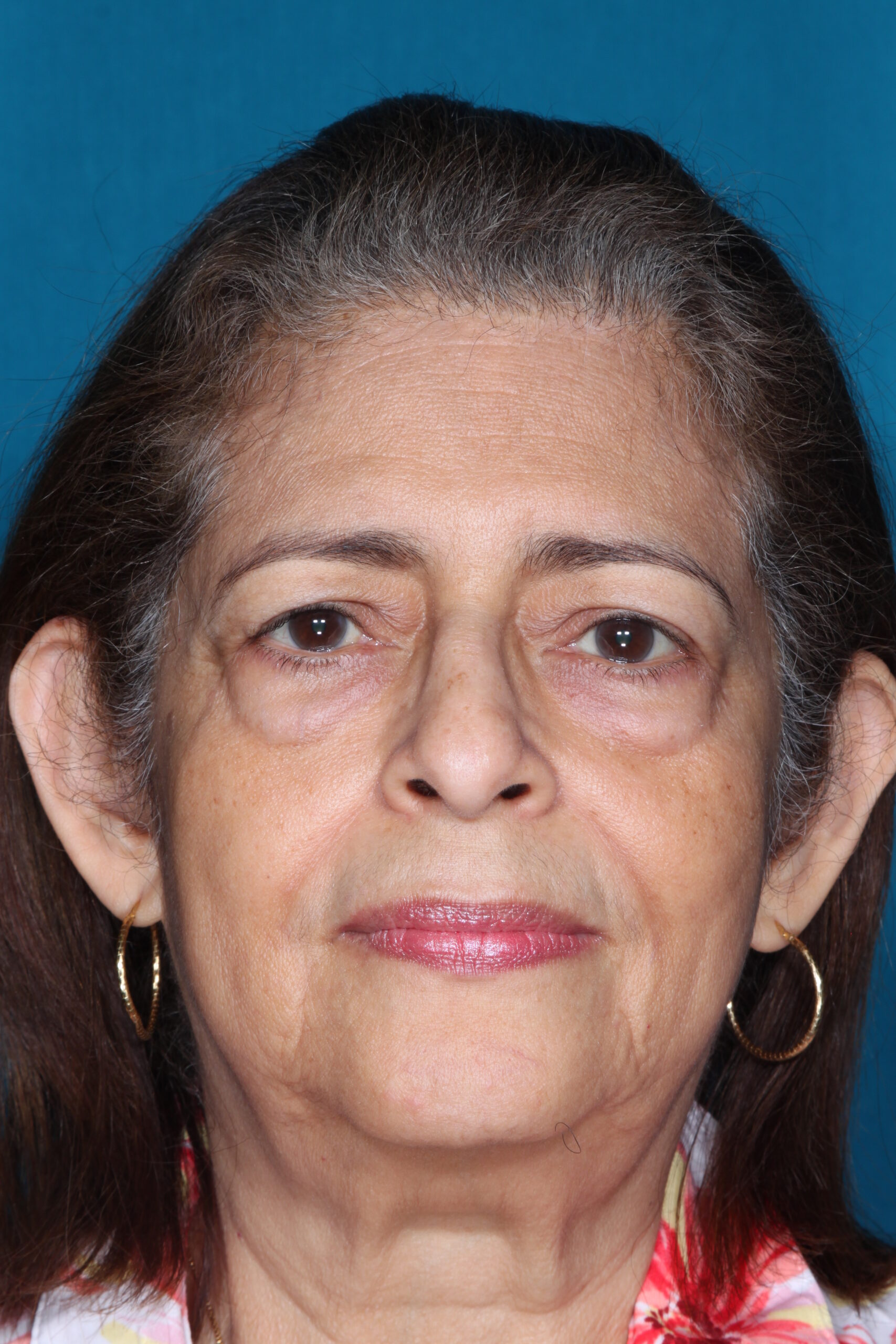
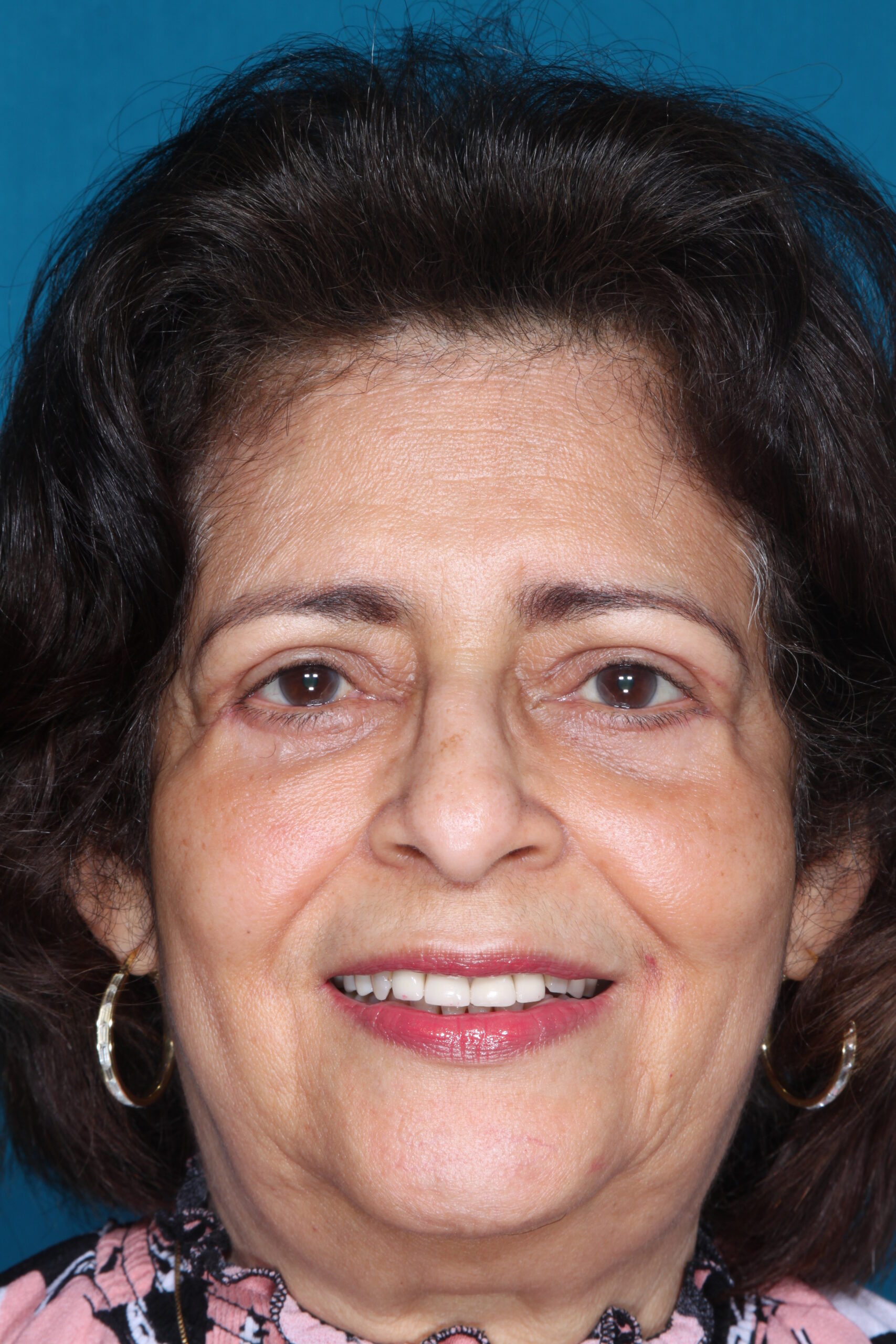
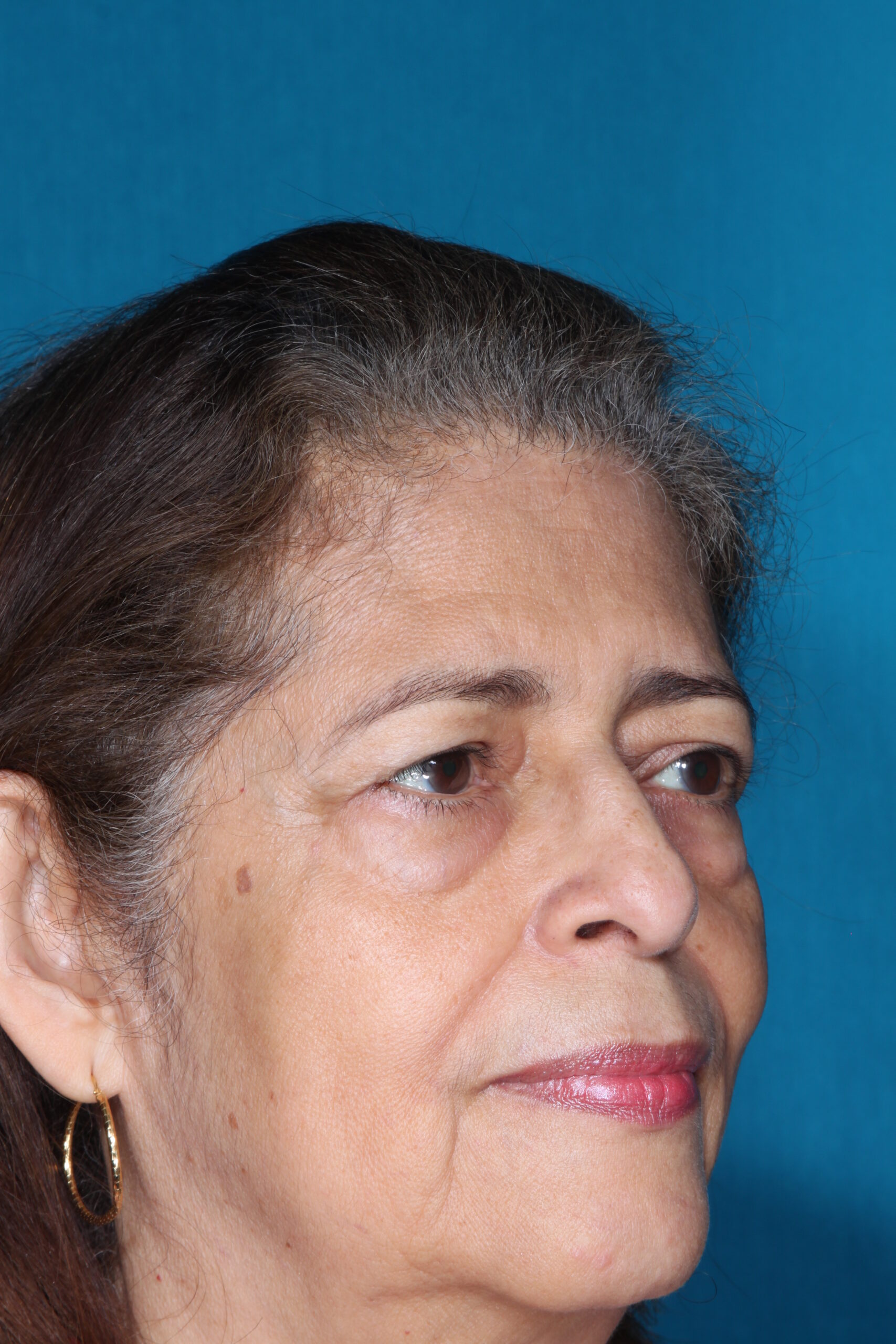
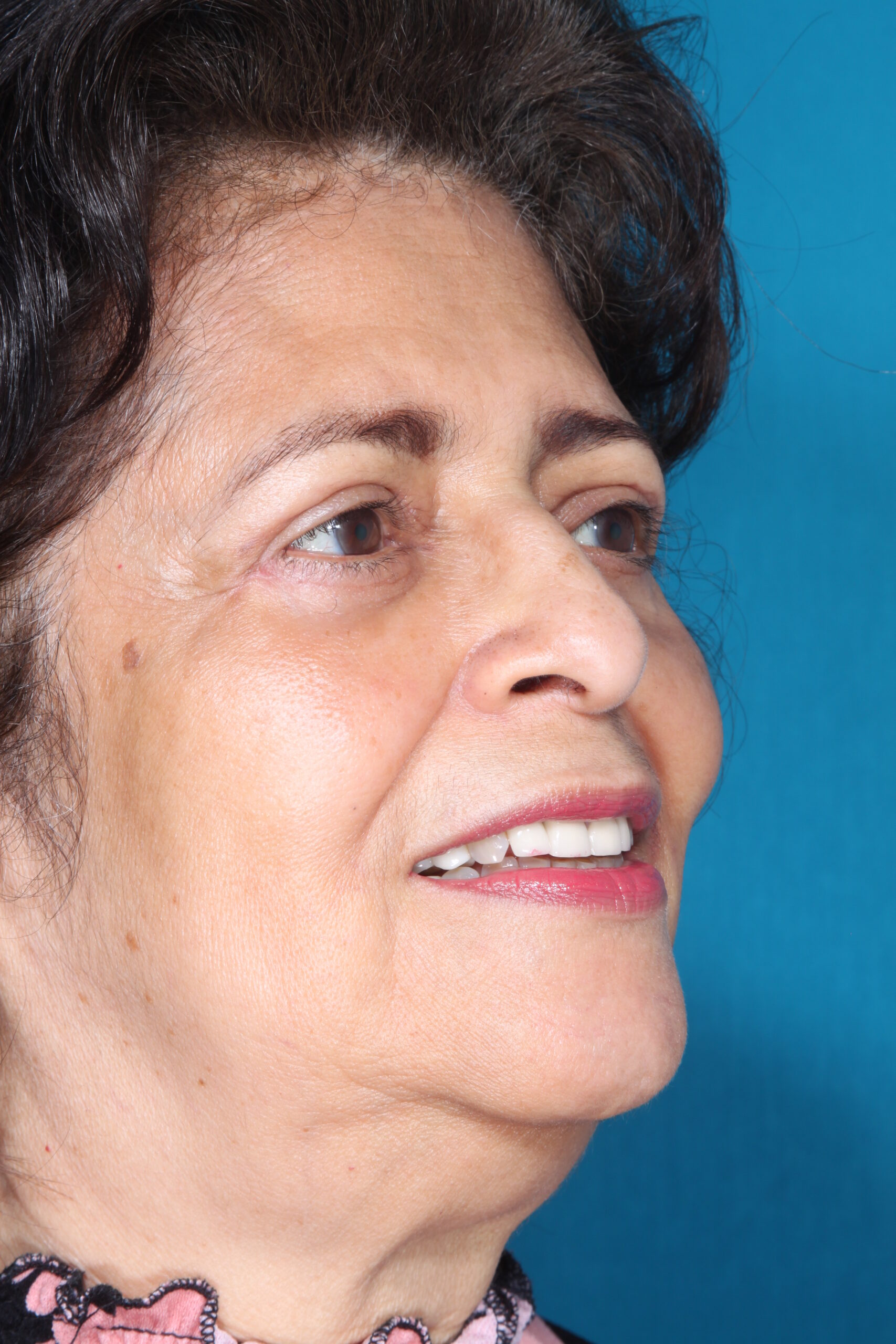
Brow/Forehead Lifts
Drooping of the eyebrows and wrinkles of the forehead are the usual reasons to consider surgical management to raise the brows into their normal position and weaken the muscles that cause forehead wrinkles. Although Botox gives some partial and temporary relief for both of these conditions, surgical management gives more lasting results. Brow lifts can be done using an endoscope through small incisions in the hairline or as part of a forehead lift with skin removal at the hairline. Brow lifts are often recommended to enhance the appearance of the eyebrow complex at the time of a blepharoplasty.
Brow lifts and forehead lifts are still done at times with open surgery if patient is having other procedures such as a rhytidectomy (facelift) or eyelid lift (blepharoplasty). These open procedures involve ranges from small incisions to incisions completely around the hairline. One of the “secrets” in Skin Secrets is that surgery is not always necessary to look better. There is nowhere in plastic surgery that this applies more than with the brows and forehead. The use of Botox, although temporary, can give a very natural look to reducing forehead wrinkles without the risk and expense of surgery. Brows can be elevated with Botox, CO2 laser lifting, and Ultherapy. Recent publicized photos of famous patients like Kenny Rogers have driven many potential patients to wanting something that will appear more natural. Fortunately, we have all the non-surgical methods in Skins Secrets to give our patients an alternative to open surgery.
Indications for BROW AND FOREHEAD LIFTS:
- Low hanging brows – brows are of many sizes, shapes and locations and often changed with permanent cosmetics. However, brows that hang at or below the bony rim of the eye socket will often appear low and may contribute to excessive skin of the upper lids.
- Forehead wrinkles and lines – these wrinkles and lines are caused by motion of the frontalis muscle in the forehead. The presence of these lines often betray a patient lifting brows they feel are low and pushing down on the upper eyelid skin.
Why a BROW AND FOREHEAD LIFT? As opposed to nonsurgical treatment of brow and forehead
- More permanent solution – most nonsurgical treatments such as Botox (last for 3-4 months), CO2 laser lifting (last for 2-3 years) and Ultherapy (last for 2-3 years) are relatively temporary. Open surgery lasts for 10 or more years until gravity again effects the position of the brows.
- Having another open surgery – some patients will combine a brow or forehead lift with another open procedure such as a rhytidectomy or blepharoplasty.
What to expect after a BROW AND FOREHEAD LIFT?
- Bruising and swelling – this will be present for several weeks.
- Numbness – depending upon the open approach this might involve much of the forehead and last for many months.
- Scarring – again variable depending on approach but scars are generally hidden in hairlines. Some patients with baldness are not good surgical candidates
- Asymmetry of brows – healing can lead to some mild asymmetry of brows that often can be improved with laser lifting or Ultherapy postoperatively.
- Minimal pain and staple or suture removal in 10 days – most patients find Tylenol or Tylenol with a narcotic to be adequate for pain relief.
What should I do next to get more information about BROW AND FOREHEAD LIFT?
- Watch the Dr. Smith videos – just click on “Dr. Smith videos” in section above
- View “before and after” pictures – just click on “before and after” photos in section above
- Schedule consultation with Dr.Smith – call the office or use the 24/7 chat after hours to schedule a private and personal consult with Dr. Smith
Photo gallery coming soon.
Rhytidectomy (Face Lift Surgery)
A face lift is often combined with lifting and tightening of the skin of the neck (Neck Lift). Removal of skin and pulling the tissue deep in the face and neck will give a noticeable and lasting tightening of the face and neck. Dr. Smith will discuss the amount of tightening that the patient wants to achieve as it relates to maintaining a natural but more youthful appearance to the face. The goal is for the patient to avoid a “plastic appearance” while reducing loose skin and wrinkles that betray the patient’s chronological age. This procedure is often combined with other tightening procedures (such as the CO2 Laser) after the surgery to fine-tune the final result.
Face lifting surgery often involves not only lifting the tissues of the face but also the neck. Most patients will require both for best results. Also, many patients will desire removal of fat from the neck (cervical liposuction) with bringing the edges of the neck muscles together in the midline of the neck (cervical platysmal plication). Some patients will consult with Dr. Smith and request at “mini lift”. There is really no such procedure unless the patient wants “mini results”. Recent history showed this with the rise and fall of the “life Style Lift” that was advertised so heavily until a few years passed and patients realized that results were minimal and fleeting. Similar results have been noted with facial threading. Dr. Smith has been doing and observing facelift surgery results for over 40 years. He has seen much come and go. The standard rhytidectomy that he will recommend to most of his patients has stood the test of time for longevity and a natural appearance. In consultation, Dr. Smith will speak with you very frankly about your desires and expectations. If he feels that you would be better served by an alternative procedure to meet your expectations, he will advise you toward that. If you have desires that he feels he cannot meet, he can refer you to someone who may better serve you. A consultation with Dr. Smith will no doubt be very helpful in your journey to discovery the right procedure and right surgeon. If you are a current smoker, Dr. Smith will advise you to NOT have a facelift due to risk of vascular damage to skin flaps.
Indications for RHYTIDECTOMY:
- Aging face beyond what can be adequately corrected with non-surgical treatment – although many patients are now seeking a facelift earlier in their aging process, sometimes especially with older patients, surgery is the overall best option.
- Patient has desire for rapid correction of aging face – many patients have a desire to rapidly and sometimes dramatically change their facial appearance. Non-surgical options are often more gradual and less dramatic
Why at RHYTIDECTOMY? As opposed to non-surgical forms of lifting and tightening the face and neck
- Sometimes patient’s needs are best suited to a surgical approach – often patients seek consultation with Dr. Smith when they are frankly “too far gone” to benefit completely from non-surgical procedures alone.
- Patients with muscle (platysmal) banding in neck will need surgery – these bands that show up as straight or oblique lines down the middle of the neck will need to be surgically sutured together for best results.
- Patients who desire another open procedure – sometimes patients want a more complete makeover in one setting, e.g. adding blepharoplasty.
What to expect after a RHYTIDECTOMY?
- Bruising and swelling – this is variable as with other procedures. Dressings and drains overnight and then wearing a neck/facial compression sling for two weeks to standard. Bruising is expected for up to two weeks.
- Moderate pain – most patient experience moderate pain requiring Tylenol combined with narcotic for a few days and then Tylenol alone for a week for best relief.
- Suture and Staple removal – generally done in 7-10 days.
- Scarring – most of scarring is hidden in hairlines or along nature skin creases
- Need for more tightening – most surgeons will combine a laser treatment of the skin with face lifting. Dr. Smith prefers to do a Laser Lift about 6 weeks after the facelift to allow skin flaps to fully recovery before undergoing further tightening of fine wrinkles that face lift cannot address completely.
What should I do next to get more information about RHYTIDECTOMY?
- Watch the Dr. Smith videos – just click on “Dr. Smith videos” in section above
- View “before and after” pictures – just click on “before and after” photos in section above
- Schedule consultation with Dr.Smith – call the office or use the 24/7 chat after hours to schedule a private and personal consult with Dr. Smith
Photo gallery coming soon.
Liposuction
Removal of fat—usually from the neck—will often improve the contour and tightness achieved with a face or neck lift. This is done through a small incision hidden in the skin of the neck just under the chin. Although the fat is usually discarded, in some cases, these fat cells may be transferred to the soft tissue of the face to give a desired plumping needed in some patients. It is normal to have some mild irregularity and lumpiness initially after liposuction, which typically resolves over several months.
Fat, particularly in the area under the chin (submental), can be hereditary and not related to percentage of overall body fat. Some patients after extreme weight loss, still are plagued with this. Although the advent of Kybella as an injectable fat dissolver is very helpful, some patients have neck bands that are prominent and/or skin laxity that persists after the fat is dissolved. For patients with persistent fat or banding issues, many times the best procedure is to remove the fat with suction lipectomy and often combine this with suturing the edges of the platysma muscles together in a procedure called platysma plication. Suction lipectomy is done with a small cannula attached to high suction to literally vacuum the fat from under the chin and around in the neck. This is generally done by Dr. Smith in his private surgery center and is often combined with either a face and/or neck lift.
Indications for LIPOSUCTION:
- Fat in the neck or under the chin – although weight loss can help many patients prepare for their best surgical results with facial rejuvenation surgery, there are times that the fat is persistent despite adequate weight loss. Suction lipectomy can remove this.
- Part of another open procedure – many times Dr. Smith will add suction lipectomy to face lifting to give better contouring to the jaw and neck lines.
Why a LIPOSUCTION? As opposed to other ways of removing fat
- Suction lipectomy can remove fat quickly and effectively – although skin tightening is adequate for many patients to improve the neck lines and compress submental fat. Although Kybella is wonderful for dissolving fat, there are many times when patient desires more complete and rapid fat removal
- Can be combined cost effectively with facelift – many patients who desire liposuction, also would benefit from face lifting. With patient already in OR for the face lift, the liposuction is less expensive as an add-on procedure.
What to expect after LIPOSUCTION?
- Bruising and swelling are moderate – extent of this is less if the liposuction is done as standalone procedure. Usually resolved in 7-10 days.
- Moderate discomfort – most patient take Tylenol with narcotic for 1-2 days then just Tylenol for another week.
- Compression dressing – we recommend compression dressing starting the day after bandages and/or drains removed. Will recommend compression dressing for two weeks to aid in flap rejuvenation.
What should I do next to get more information about LIPOSUCTION?
- Watch the Dr. Smith videos – just click on “Dr. Smith videos” in section above
- View “before and after” pictures – just click on “before and after” photos in section above
- Schedule consultation with Dr.Smith – call the office or use the 24/7 chat after hours to schedule a private and personal consult with Dr. Smith
Photo gallery coming soon.
External Ear Repair (Otoplasty)
Otoplasty is the plastic surgical repair of congenital deformity of the ears (referred to as “bat ears”). This is the source of ridicule and bullying for many children with this issue especially when they start school and classmates notice that the ears stick out more than normal. This can be repaired usually starting any time after age 5.
The deformity causing the ears to protrude often involves the lack of curling of the outer ear cartilage and the prominence of the base of the ear cartilage. The desire of most parents who have children with this condition is not to remake the entire ear but to simply correct and reposition the ear so that the appearance is not recognized as protruding un-naturally. This correction is generally done under general anesthesia in Dr. Smith’s private surgery center. The plastic surgery repair often involves removing, repositioning and suturing cartilage with permanent sutures buried deep within the ear tissues. Most parents and patients find this procedure to be very satisfying and a vast improvement over the original appearance of the ears.
Indication for EXTERNAL EAR REPAIR (OTOPLASTY):
- Appearance of the ears that is perceived to be “un-natural” – many parents and patients have a difficult time voicing the exact problem but the overall appearance draws unwanted attention to the ears.
Why EXTERNAL EAR REPAIR (OTOPLASTY)? As opposed to other therapy.
- No other methods of correction are available – surgical repair is the only method to correct this deformity
What to expect after EXTERNAL EAR REPAIR (OTOPLASTY):
- Every ear has a unique appearance – this surgery is aimed at making the patient’s ear appear more normal in public. This is not a procedure to make a patient’s ear look exactly like someone else’s ear.
- Dressing and ear bandages – most patients will have compressive dressing over both ears for 1-3 days. This compression will aid in healing and reduce discomfort. After the dressing is removed, the ears will need protection from distractive forces until healed. Normally protective ear cups are used for this purpose for up to 6 weeks.
- Minimal to moderate pain – usually Tylenol sometimes adding codeine will control discomfort.
What do I need to do next to get more information on EXTERNAL EAR REPAIR (OTOPLASTY)?
- Watch the Dr. Smith videos – just click on “Dr. Smith videos” in section above
- View “before and after” pictures – just click on “before and after” photos in section above
- Schedule consultation with Dr.Smith – call the office or use the 24/7 chat after hours to schedule a private and personal consult with Dr. Smith
Photo gallery coming soon.
Skin Cancer Removal/Reconstruction
Most lesions on the skin are benign. However, especially in sun exposed areas such as the face, neck and arms, sun damage can lead to development of skin cancer. Skin cancers are generally of 3 types: basal cell, squamous cell and melanoma. Surgical excision, sometimes combined with radiation, can generally treat the first two types of cancer. Melanoma is often systemic in nature and requires treatment with an oncologist. Dr. Smith sees many patients who are questioning about whether a skin lesion might be cancer. Treatment first starts with the correct diagnosis. Dr. Smith can do a biopsy and if cancer is found, normally treat this with excision and plastic reconstruction as needed either in the office or his private surgery center.
Dr. Smith has been treating skin cancers for over 40 years. He specializes in skin cancers of the face and neck because reconstruction of the surgical defects often requires plastic surgery to reconstruct these with the least scarring. Dr. Smith receives referrals for treatment of skin cancers from family doctors, dermatologists and Mohs surgeons. Evaluation, biopsies, cancer removal and reconstructions are usually covered by insurance including Medicare. Dr. Smith does the biopsies in the office under local anesthesia. Once the exact type of cancer is diagnosed, then Dr. Smith with outline treatment plan that will usually include excision and reconstruction of the area. With complete excision of the skin cancer along with correct margins of normal tissue, most skin cancers can be completely removed before spreading. Reconstruction of tissue defects are done with variety of techniques depending on size and location. Most reconstruction can be done in office under local anesthesia at time of cancer removal.
Indications for SKIN CANCER REMOVAL AND RECONSTRUCTION:
- Presence of skin cancer – most skin cancers can be removed surgically and will normally not recur in same area.
- Extent of skin removal depends upon type of cancer – most basal cell carcinomas will be “cured” with removal of 1-2mm of normal skin. Squamous cell cancers require larger margins and possible monitoring for spread to other areas of body.
- Reconstruction of defect – may be simple closure with sutures or may require skin flaps or grafts for best plastic closure.
Why SKIN CANCER REMOVAL AND RECONSTRUCTION? As opposed to scraping, burning, freezing, radiation or Mohs surgery
- Removal of skin cancer can be curative – other methods such as scraping, freezing and burning often don’t completely kill the cancer cells and have high rates of recurrence.
- Complete removal can be documented after removal – unlike other methods, removal allows doctor and patient to know that all the cancer was removed or NOT. If not, more can be removed.
- Removal and reconstruction allow best cosmetic result – other than radiation (where no skin is removed), removal and reconstruction allows Dr. Smith to do plastic closure for best appearance of the skin.
- Faster and less expensive than Mohs surgery – removal and immediate closure is overall faster and less expensive than a procedure done by dermatologist known as Mohs surgery where surgical margins are looked at during the surgery. Mohs surgery is generally only indicated in critical areas where there is a need to preserve as much normal tissue as possible with the cancer excision. Cosmetic closures, for defects left by Mohs surgery, are often done by a plastic surgeon such Dr. Smith several days after the initial surgery unless surgeries are coordinated ahead a time.
What to expect after SKIN CANCER REMOVAL AND RECONSTRUCTION?
- Healing incision – the area where lesion was removed in now closed with sutures. The sutures you see will probably need removal. Sutures deeper in tissue will dissolve over a period of time.
- Keep incision clean of crusting and moisten with ointment – several times daily, crust removal with ½ strength peroxide and sterile water using Q-tip is recommended. Keep incision moist with antibiotic ointment.
- Minimal pain – Tylenol as needed is usually all that is needed.
- Suture removal – generally done in 7-10 days
What should I do next to get more information about SKIN CANCER REMOVAL AND RECONSTRUCTION?
- Watch the Dr. Smith videos – just click on “Dr. Smith videos” in section above
- View “before and after” pictures – just click on “before and after” photos in section above
- Schedule consultation with Dr.Smith – call the office or use the 24/7 chat after hours to schedule a private and personal consult with Dr. Smith
Photo gallery coming soon.